
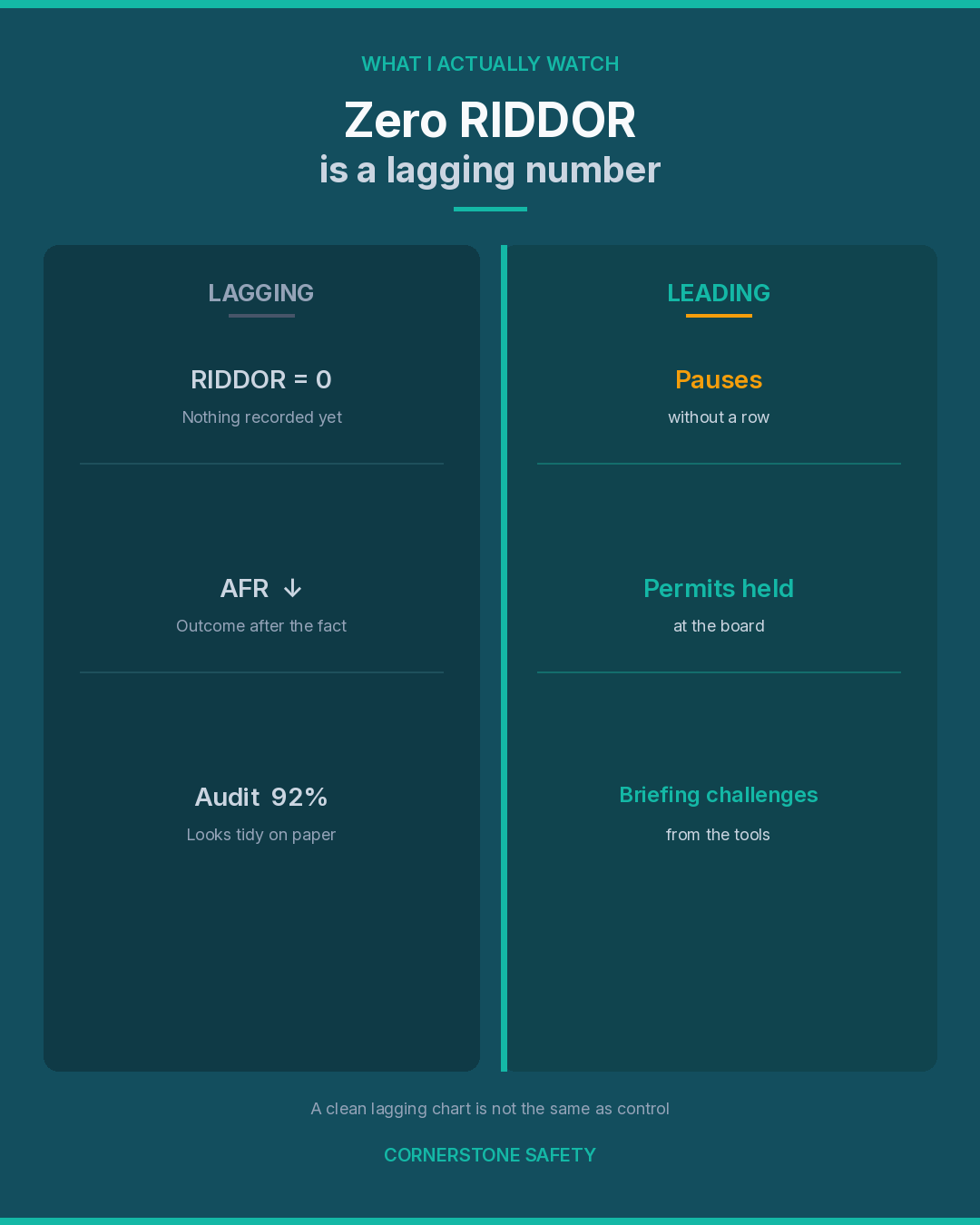
Zero RIDDOR Is a Lagging Number
Stop-Work Authority That Actually Gets Used

The Supervisor Who Stops the Job When No One Is Watching Is Worth More Than Any Policy
You can have the thickest RAMS folder on the project.
You can have laminated site rules, golden rules, and a policy signed by every director.
You can have toolbox talks delivered on schedule and induction records that would satisfy any auditor.
None of it matters if the supervisor on the night shift, or the one working the quiet corner of the site on a Friday afternoon, chooses production over protection when no one is looking.
That single decision — to stop the job when it is safer to stop — is the clearest signal of whether your safety culture is real or just paperwork.
Paper does not stop incidents. People do.
Every serious incident investigation eventually reaches the same uncomfortable truth: the controls existed on paper, but they were not applied in the moment that mattered.
Why?
Because the people closest to the risk did not feel able, or did not feel supported, to pause the work.
Under the Construction (Design and Management) Regulations 2015 and the Management of Health and Safety at Work Regulations 1999, employers must provide effective supervision. Supervision is not a job title. It is an active duty. It includes the authority — and the expectation — to stop work that is unsafe or that has drifted from the agreed safe system of work.
Yet many organisations still treat stop-work authority as a policy statement rather than a lived behaviour. They write it once, put it in the induction, and hope for the best.
Hope is not a control measure.
What “stopping the job when no one is watching” actually looks like
It is the temporary works supervisor who refuses to load the next lift until the bracing has been checked, even though the crane is waiting and the programme is tight.
It is the shift supervisor who stops a night-time concrete pour because the edge protection has been removed to allow access and has not been properly reinstated.
It is the team leader who sends the operatives back to the welfare cabin while a last-minute change to the method is properly risk-assessed and communicated — knowing full well that the client’s agent is standing nearby with a stopwatch.
These actions rarely appear in the daily progress report. They do not generate positive press. They often create short-term friction.
They also prevent the incidents that destroy lives, careers, and companies.
The value of that supervisor is not measured in the number of toolbox talks they deliver or the number of near-miss cards they submit. It is measured in the absence of the incident that never happened because they chose to stop.
Why most policies fail this test
Most safety policies are written for the auditor, not for the supervisor under pressure.
They use language that is legally precise but practically weak. They rarely address the real barriers:
Production pressure from clients and commercial team
Fear of being seen as “difficult” or “not commercial”
Lack of visible support from senior leaders when a stop-work decision is challenge
Inadequate competence in the specific hazards of the task
No clear process for resolving the issue quickly so work can restart safely
When a supervisor has previously been criticised (even subtly) for stopping work, the next time they will calculate the personal cost before they calculate the risk.
That calculation is the culture.
Building supervisors who will stop the job
If you want supervisors who will act when no one is watching, you cannot rely on a policy clause. You need a deliberate system.
1. Select for values as well as technical competence
Look for people who have already demonstrated they will speak up. Ask behavioural interview questions about times they challenged unsafe work. Technical skill without moral courage is a liability in a supervisory role.
2. Make stop-work authority non-negotiable and visible
Every supervisor must understand that exercising stop-work authority is not optional. It is a core part of their job description. Senior leaders must publicly thank people who use it, especially when it creates short-term delay.
3. Give them the competence and the tools
A supervisor cannot stop work effectively if they do not understand the hazards. Provide task-specific training, clear RAMS that they have helped shape, and easy access to competent advice when they need a second opinion.
4. Remove the fear of consequences
Investigate every instance where a stop-work decision was later questioned. If the decision was reasonable, protect the supervisor. If it was not, use it as a learning opportunity rather than a disciplinary one. The first time a supervisor is punished for stopping work (even informally), you have taught the entire workforce the real rule.
5. Measure the right things
Track stop-work events as a leading indicator. Celebrate them. Ask in every safety conversation: “When did you last stop a job, and what happened afterwards?”
The CDM and legal reality
Under CDM 2015, the principal contractor must ensure that the construction phase is planned, managed and monitored so that it is carried out without risks to health and safety so far as is reasonably practicable. Effective supervision is central to that duty.
Workers themselves have a legal duty under Section 7 of the Health and Safety at Work etc. Act 1974 to take reasonable care and to co-operate. They also have the right — and in serious cases the obligation — to stop work where there is serious and imminent danger (Management of Health and Safety at Work Regulations 1999, Regulation 8).
A supervisor who fails to stop unsafe work is not just failing a company policy. They may be failing a legal duty. A company that discourages stop-work decisions is creating the conditions for enforcement action and, worse, for preventable harm.
What this looks like in practice on real projects
On high-performing sites we support, the difference is obvious within the first week.
Supervisors talk about risk in plain language. They own the method statements rather than treating them as documents written by someone else. They brief their teams as if the work actually depends on it — because it does. And when something changes (and something always changes), they pause, reassess, and only restart when the controls are right.
These sites do not have fewer challenges. They have fewer surprises that turn into incidents.
The real cost of the alternative
The alternative is the supervisor who looks the other way because “it’s only for five minutes” or “the client is pushing” or “we’ve always done it this way.”
That decision is rarely recorded. The near miss that follows is often not reported. The serious injury that eventually occurs is then investigated as a “failure of the system” when, in truth, the system had already failed the moment the supervisor chose not to stop.
Policies cannot compensate for that moment of human choice. Only culture can.
A practical next step
If you are a director, project manager or principal contractor reading this, ask yourself one question this week:
When was the last time one of our supervisors stopped a job, and how did we respond?
If you cannot answer that question clearly and positively, you do not yet have the culture you think you have.
At Cornerstone Safety we help contractors and clients build the practical systems that make stop-work authority real: usable RAMS written for the people who actually do the work, competency matrices that identify the right supervisors for the right tasks, toolbox talks that stick, and ongoing support that backs site leaders when it matters.
If you want supervisors who will stop the job when no one is watching — and a culture that supports them when they do — we should talk.
Book a free 15-minute call.
We will listen to your current challenges, outline practical options, and tell you honestly whether we can help.
No obligation. No hard sell. Just a clear conversation about what actually works on site.
or email support@cornerstone-safetyltd.co.uk
About the author
Andrew Souter is the founder of Cornerstone Safety Ltd, a practical health and safety consultancy based in the North East and working nationwide. With experience across construction, industrial, recycling and regulated sectors, he focuses on documents and systems that are used on site rather than filed away.
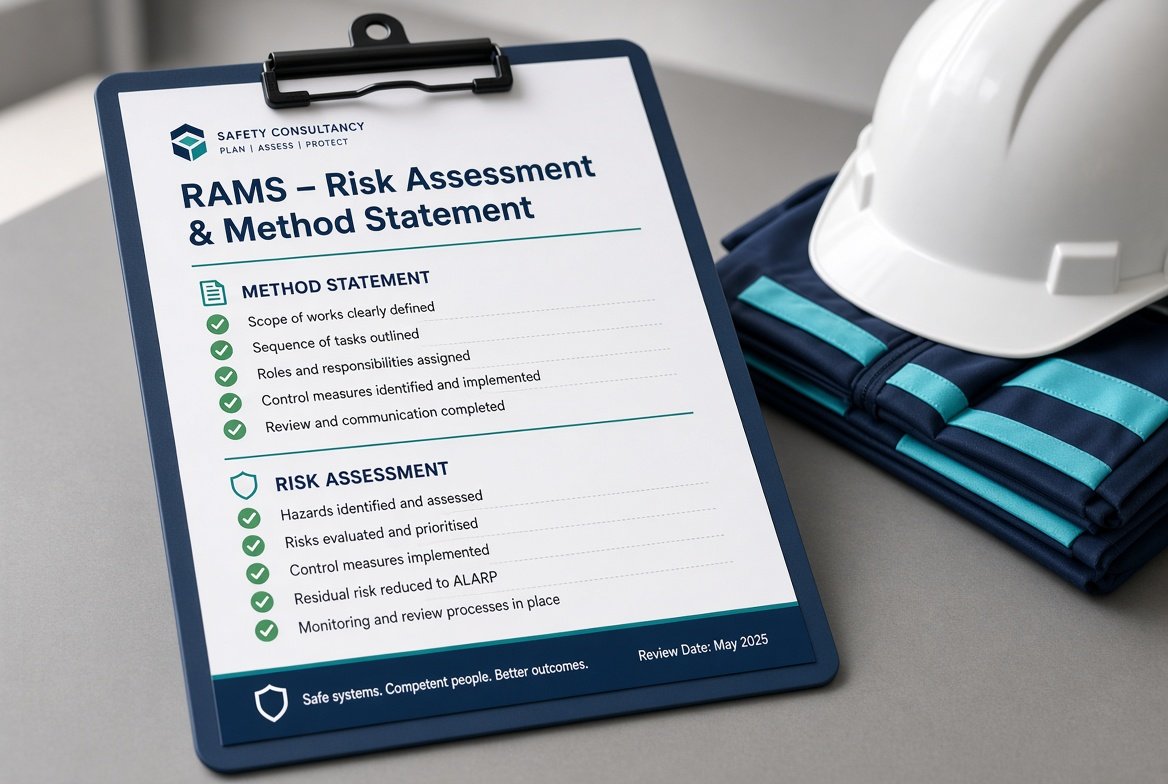
Most Risk Assessment and Method Statements (RAMS) fail audits for the same handful of reasons. They look comprehensive on the surface, but when examined properly they fall short of what CDM 2015 and good practice actually require.
As a result, contractors waste time rewriting documents, projects face delays, and — more importantly — the workforce is left with paperwork that doesn’t properly control the risks on site.
This post breaks down why most RAMS fail, the most common pitfalls we see, and a practical checklist you can use to get them right first time.
Why Most RAMS Fail Audits
Auditors (whether client, principal contractor, or external) are not looking for volume. They are looking for evidence that the significant risks have been identified, assessed, and controlled in a way that is specific to the task, the site, and the people doing the work.
Generic, copy-and-paste documents almost always fail this test.
Common Pitfalls That Cause RAMS to Fail
Here are the issues we see most frequently:
Generic content that could apply to any site The same method statement is submitted for multiple projects with only the project name changed. Site-specific hazards, interfaces, and constraints are missing.
Risk assessments that don’t match the method High residual risks remain after controls are applied, or the controls listed in the risk assessment are not reflected in the actual sequence of work.
No clear sequence of work The method statement describes what will be done but not how it will be done step-by-step, making it difficult to brief the team or supervise the activity.
Inadequate consideration of interfaces and SIMOPS Other contractors, overlapping work, or existing site activities are not properly addressed.
Weak or missing emergency arrangements Rescue plans, first aid, and emergency procedures are either generic or absent for higher-risk activities (work at height, confined spaces, lifting, electrical work, etc.).
Competency requirements not defined The document does not clearly state what training, qualifications, or authorisations are required for the people carrying out the work.
No evidence of briefing or acceptance There is no system shown for ensuring the workforce has actually been briefed on the RAMS before starting work.
Free Downloadable RAMS Quality Checklist
We’ve created a practical one-page checklist you can use when writing or reviewing method statements. It covers the seven areas that most commonly cause documents to fail audits.
[Download the Free RAMS Quality Checklist (PDF)]
Use it as a quick pre-submission check or as part of your internal review process.
Best Practice Principles
Strong RAMS share several characteristics:
They are written by (or with significant input from) people who understand the work.
They focus on the significant risks rather than trying to list every minor hazard.
Controls are practical and can actually be implemented on site.
The document is treated as a live tool for briefing and supervision, not just a compliance exercise.
They are reviewed and updated when conditions change.
Conclusion
Poor quality RAMS create false confidence. Good quality RAMS protect people, reduce rework, and stand up to scrutiny.
Getting them right is not about producing longer documents — it is about producing clearer, more specific, and more practical ones.
Need a second pair of eyes on your RAMS?
Cornerstone Safety Limited offers independent RAMS reviews for contractors and principal contractors. We identify gaps quickly and provide clear, practical feedback so your documents are audit-ready and, more importantly, useful on site.
Contact us for a confidential discussion or to arrange a free initial review of one of your method statements.
CDM 2015 in Action: Delivering a £70m Advanced Recycling Facility Safely and On Schedule
Delivering a major industrial construction project on time and without major incident is never straightforward — especially when it involves complex recycling technology, multiple contractors, and high-risk commissioning phases.
Cornerstone Safety Limited, recently completed a 15-month engagement as on-site H&S Manager/Consultant for a £70 million Advanced Recycling Facility (ARC) in Shrewsbury. The results speak for themselves: 1,247 site-specific inductions, 84 companies managed, 2,150 permits issued, and strong overall performance with only one isolated RIDDOR lost-time injury.
Here’s how we put CDM 2015 principles into practice to achieve this outcome.
Understanding the Project Challenges
The project involved construction of a state-of-the-art facility to process post-consumer plastic bottles into high-quality recycled Polyethylene terephthalate (PET). Key complexities included:
Installation and commissioning of advanced optical sorting systems
Heavy mechanical equipment including; industrial shredders, extensive conveyor networks, flake wash line, and flake sorting systems
High-voltage and Low-voltage electrical installation and integration
Confined space work, lifting operations, and work at height
Simultaneous construction and commissioning activities (SIMOPS)
Strict environmental and waste management requirements
These factors demanded a proactive, rather than reactive, approach to health and safety.
Applying CDM 2015 – The Cornerstone Approach
1. Strong Client & Principal Designer Collaboration From the earliest phases we worked closely with the client and design team to ensure health and safety was designed in. This included early risk workshops and input into temporary works and permanent design solutions.
2. Robust RAMS & Permit Systems Implementation of a comprehensive Risk Assessment and Method Statement (RAMS) review process. Every contractor’s method statement was thoroughly reviewed and approved before work began — with 220 RAMS reviewed to date. Our permit-to-work system managed high-risk activities such as electrical isolation, hot works, and lifting operations — issuing 2,150 permits with strong control throughout.
3. Comprehensive Induction & Training Programme We delivered 1,247 site-specific inductions, supplemented by 70 toolbox talks and 342 daily safety points. This ensured every worker understood the site-specific risks and kept engagement high throughout the project.
4. Temporary Works Supervision (TWS) Provided a Temporary Works Supervisor, who supported the Temporary Works Coordinator in the day-to-day oversight of all temporary works throughout the project, ensuring compliance with BS 5975 and project-specific requirements.
5. Safe Commissioning Phase The transition from construction to commissioning is often where incidents occur. We developed detailed isolation and LOTO procedures, SIMOPS risk assessments, and maintained strict permit control during the integration of complex machinery. We also supported the development of a suite of operational Safe Operating Procedures (SOPs) for key plant and equipment, helping ensure a structured and safe handover into the operational phase.
Key Results Achieved
One isolated RIDDOR lost-time injury (immediate corrective action taken)
1,247 workforce inductions completed
84 contractors successfully managed under one safety framework
2,150 permits issued and controlled
220 RAMS reviewed
70 toolbox talks delivered
Positive feedback from client, principal contractor, and supply chain
Smooth progression through construction into commissioning
Lessons Learned & Recommendations
Start safety early — involve the safety team from the design phase.
Treat RAMS as living documents — regular reviews and updates are essential.
Communication is critical during SIMOPS and commissioning.
Metrics matter — track leading indicators (permits, inductions, near-misses) as well as lagging ones.
Culture beats paperwork — visible leadership and workforce engagement make the biggest difference.
Conclusion
This project demonstrates that excellent safety performance and project delivery are not mutually exclusive — they are mutually reinforcing when approached with the right expertise and systems.
At Cornerstone Safety Ltd we specialise in translating CDM 2015 requirements into practical, on-site solutions that protect people and enable successful project outcomes.
Ready to strengthen safety performance on your project?
Whether you’re in the construction, recycling, manufacturing, or industrial sectors, contact us today for a no-obligation discussion about how we can support your team.